Grid Resilience Under Climate Stress: How TSOs and DSOs Are Adapting
How are TSOs and DSOs adapting power grids to escalating climate hazards? From substation flood protection to N-K contingency analysis, explore the strategies driving grid resilience investment across Europe.
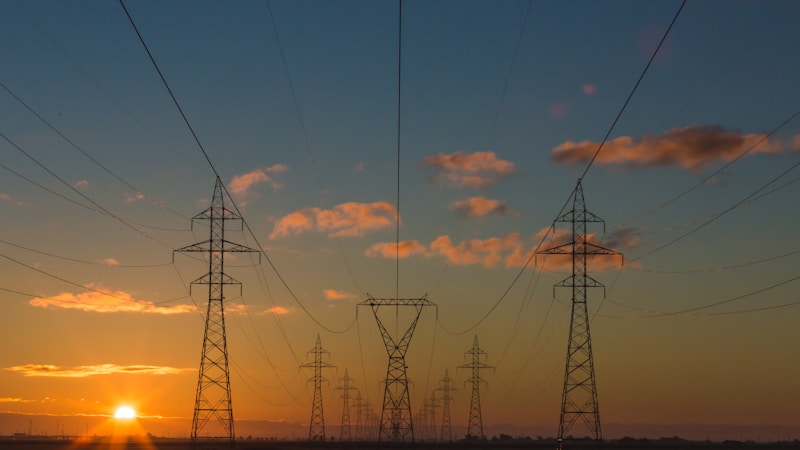
In January 2025, Storm Eowyn struck the British Isles with unprecedented wind speeds, leaving one million premises without power across Northern Ireland and the Republic of Ireland. This event represents not an outlier but a data point in an accelerating trend: grid operators can no longer rely on historical weather baselines for infrastructure planning. Extreme precipitation, chronic heat stress, and intensifying storms are fundamentally rewriting operational conditions for European power grids.
The shift underway among transmission system operators (TSOs) and distribution system operators (DSOs) is comprehensive, moving from reactive emergency management toward proactive, climate-informed infrastructure adaptation.
Primary Climate Hazards Reshaping Grid Operations
Extreme Precipitation and Flooding
Flooding has become the dominant driver of capital expenditure exposure across European grid assets. Substations face particular vulnerability - inundation beyond 0.3-0.5 metres compromises switchgear, transformers, and control systems. The operational impact extends beyond equipment damage; access roads and maintenance routes become impassable during flood events, significantly extending restoration timelines and outage durations.
Chronic Heat Stress
Rising baseline temperatures quietly degrade equipment performance long before catastrophic failure occurs. Transformer capacity declines under sustained heat. Overhead line conductors sag as temperatures rise, reducing ground clearance and triggering automatic safety disconnections. Grid-connected inverters derate above 40°C, with efficiency losses reaching 60% by 55°C.
Heat-driven increases in fault rates and outage durations are projected to increase SAIDI by 9% by 2030 in regions like Germany and Belgium from wind hazards alone. In southern Europe, heat-driven outages could triple by 2050.
Wind and Storm Intensification
In February 2022, Storm Eunice damaged tens of thousands of kilometres of overhead lines across more than 1,800 locations in the UK, with losses exceeding GBP 300 million. Engineering margins designed for historical 50-year return periods are now being tested by events arriving with increasing frequency.
These hazards rarely occur in isolation. A flood disabling a critical substation during a concurrent heatwave pushing demand to peak creates cascading network failures - the type that traditional N-1 contingency models were never equipped to predict.
TSO vs. DSO: Understanding Asymmetrical Vulnerabilities
Transmission Networks (TSOs)
TSOs manage fewer, higher-value assets: extra-high-voltage substations, interconnectors, and transmission towers. The defining characteristic is systemic criticality - a single transmission failure cascades across regions, potentially triggering load shedding for millions of customers. Climate exposure concentrates on wind loads against tower structures, flood risk at major substations, and thermal limits on long-distance conductors.
Distribution Networks (DSOs)
DSOs operate vast, dispersed asset portfolios: thousands of kilometres of medium-voltage overhead lines, local substations, and distribution transformers. Physical exposure runs higher; more overhead lines traverse vegetated corridors, more assets sit in flood plains, and more equipment faces direct environmental contact. Heavy precipitation stands as the primary fault driver.
The practical implication is unambiguous: one-size-fits-all resilience strategies fail. TSOs need systemic criticality mapping identifying where compound failures cascade into network-wide outages. DSOs need portfolio-wide hardening prioritization targeting highest-impact interventions across thousands of dispersed assets.
Leading Adaptation Strategies
Physical Hardening of Critical Assets
Substation flood protection represents the most straightforward adaptation measure and reaches breakeven rapidly. Raised foundations (50-100 cm elevation), deployable flood barriers, and switchgear waterproofing directly reduce damage probability and severity.
One European DSO completed systematic vulnerability assessment across 130 substations in critical flooding areas. The process involved physically measuring critical water heights for switch cabinets at each location. The operator has begun building mitigation measures, including foundation elevation where exposure is highest.
For overhead lines, the most effective intervention converts bare conductors to semi-insulated compact conductors or aerial bundled cables. European grid data demonstrates 40-50% fault reduction on upgraded line segments, with payback periods of 3-5 years.
Operational Preparedness
Leading operators have moved beyond ad-hoc emergency response to structured, tiered crisis management. Mobile substations and emergency generators are pre-positioned at strategic network points. Real-time field reporting systems combined with smart meter outage data enable faster, more precise fault location, reducing restoration times from days to hours.
Network Design and Routing
New grid infrastructure increasingly uses forward-looking climate projections rather than historical baselines for siting decisions. Distribution lines in storm-prone corridors are being routed underground where financially justified. During Sweden’s 2005 Storm Gudrun, urban areas served by underground cables experienced outages lasting only hours, while rural overhead-dependent areas faced 20 days without power.
Digital Tools and Data-Driven Resilience Planning
Predictive Hazard Modelling
AI-driven storm damage models use real-time weather data combined with asset vulnerability profiles to predict which specific assets will fail under given conditions and timing.
Asset-Level Climate Intelligence
The shift from generic hazard maps to asset-specific vulnerability modeling represents the single most important analytical advancement for grid operators. By connecting individual asset specifications to localized hazard projections, operators identify precisely which assets face unacceptable exposure.
N-1 to N-K Resilience Analysis
Traditional contingency planning uses N-1 analysis: testing whether the system continues operating if any single component fails. Climate events break this assumption by causing spatially correlated, simultaneous failures across the network.
N-K analysis extends this framework to simultaneous failure of K components. Climate-informed N-K analysis overlays hazard failure probabilities onto network topology, identifying which component failure combinations would cascade into system-wide outages.
Shifting Regulatory Frameworks
United Kingdom: RIIO-T3
As operators enter the RIIO-T3 price control period in 2026, they transition from retrospective assessment to dynamic, forward-looking climate adaptation planning. SAIDI stability through 2050 is emerging as a rate-case approval condition.
European Union: Taxonomy, CSRD, and Climate Adaptation Plan
The EU Taxonomy requires infrastructure investments to demonstrate climate adaptation criteria for sustainable classification. CSRD reporting mandates require grid operators to disclose physical climate risk exposure across asset portfolios.
Financial Justification
The United Nations estimates that for every dollar invested in climate-resilient infrastructure, six dollars can be saved in avoided disruption and damage. Delaying action by a decade nearly doubles implementation costs.
Substation flood-proofing costs between EUR 150,000 and EUR 1.2 million per site and reaches breakeven by year six. Medium-voltage conductor upgrades break even within three to five years through reduced fault frequency.
Grid resilience under climate stress is no longer a 2050 planning exercise. The hazards exist now, eroding asset performance, testing engineering margins, and rewriting regulatory expectations in real time.
The climate data your financial models are missing.
Get climate intelligence on your portfolio - in 48 hours.
Get Your Climate Assessment